The Numbers That Tell You How a Med Spa Is Really Doing
Successful medical spas do not rely on intuition. They make decisions using data.
Key Performance Indicators (KPIs) help clinic owners and managers understand exactly how the business is performing, identify operational weaknesses, improve patient satisfaction, and increase profitability.
Without measurable performance indicators, it becomes difficult to know whether the practice is improving or simply getting busier.
Tracking the right KPIs allows leaders to make better decisions based on objective information rather than assumptions.
Why KPIs Matter
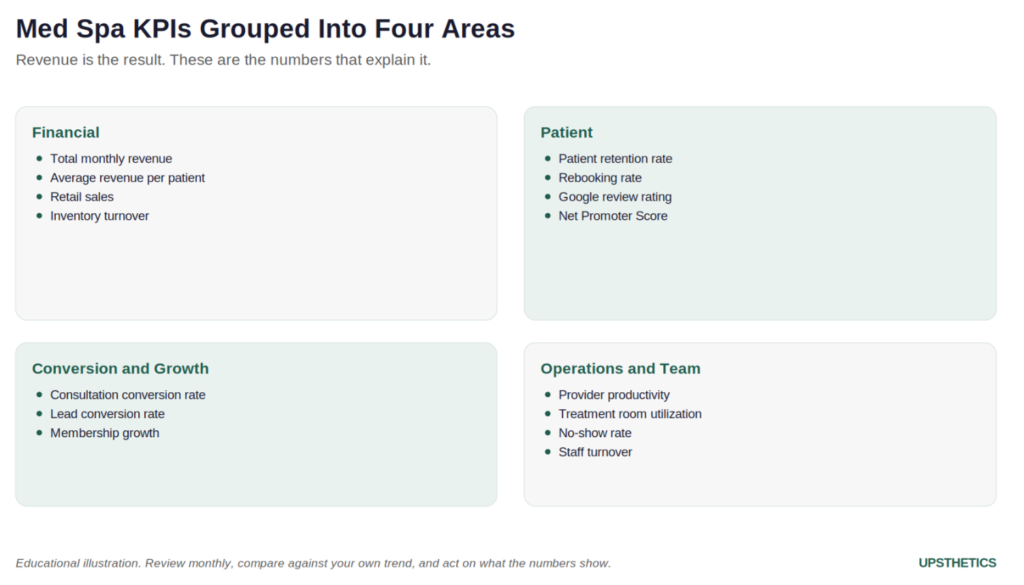
KPIs provide a clear picture of how every area of the clinic performs.
They help managers answer questions such as:
Are consultations converting into treatments?
Are patients returning?
Are providers working efficiently?
Is the schedule fully optimized?
Are marketing campaigns generating profitable patients?
Is the clinic growing sustainably?
The most successful medical spas review these numbers every month.
1. Total Monthly Revenue
This is the total amount of money generated during the month.
Although important, revenue alone never tells the whole story.
A clinic can increase revenue while becoming less profitable if expenses increase faster than income.
Revenue should always be analyzed alongside profitability.
2. Average Revenue Per Patient
This KPI measures how much revenue each patient generates on average.
A higher average often reflects:
- Better treatment planning
- Improved patient education
- Higher patient retention
- More effective membership programs
- Increased retail sales
Growing average revenue is usually more sustainable than constantly acquiring new patients.
3. Consultation Conversion Rate
One of the most important KPIs in medical aesthetics.
It measures the percentage of consultations that become paying patients.
Low conversion rates may indicate:
- Poor consultation experience
- Weak patient communication
- Pricing concerns
- Lack of trust
- Inadequate follow-up
Many successful clinics monitor this metric every week.
4. Patient Retention Rate
Acquiring new patients is expensive.
Retaining existing patients is usually far more profitable.
A strong retention rate often reflects:
- Excellent patient experience
- High treatment satisfaction
- Effective follow-up
- Strong loyalty programs
- Consistent communication
Retention is one of the strongest indicators of long-term business health.
5. Rebooking Rate
This measures how many patients schedule another appointment before leaving the clinic.
High-performing practices encourage appropriate follow-up scheduling before checkout.
A strong rebooking rate improves revenue predictability and reduces gaps in the schedule.
6. No-Show Rate
Missed appointments reduce productivity and increase costs.
Track:
- No-shows
- Late cancellations
- Same-day cancellations
Reducing missed appointments often requires:
- Appointment reminders
- SMS confirmations
- Deposit policies
- Patient education
7. Provider Productivity
Monitor productivity for each provider.
Useful indicators include:
- Patients treated
- Revenue generated
- Treatments performed
- Average treatment value
- Utilization rate
This information helps optimize scheduling and staffing.
8. Treatment Room Utilization
Treatment rooms are expensive assets.
Empty rooms generate no revenue.
Track:
- Room occupancy
- Idle time
- Scheduling gaps
- Peak demand periods
Improving room utilization often increases profitability without hiring additional staff.
9. Retail Sales
Retail skincare represents an important revenue opportunity.
Monitor:
- Retail revenue
- Products sold
- Average retail purchase
- Retail attachment rate
Patients who receive professional product recommendations often achieve better treatment outcomes.
10. Membership Growth
Membership programs improve predictable monthly income.
Monitor:
- New memberships
- Renewals
- Cancellations
- Average membership revenue
Healthy membership growth improves financial stability.
11. Lead Conversion Rate
Marketing generates enquiries.
Operations convert those enquiries into patients.
Track:
- Website enquiries
- Phone calls
- Social media leads
- Consultation bookings
- Treatment conversions
Improving lead conversion often produces better ROI than increasing advertising spend.
12. Google Review Rating
Online reputation directly influences patient acquisition.
Monitor:
- Average rating
- Number of reviews
- Monthly review growth
- Response time
A strong online reputation builds credibility and trust.
13. Net Promoter Score (NPS)
NPS measures how likely patients are to recommend the practice.
High scores usually indicate:
- Excellent patient experience
- Strong communication
- Consistent clinical outcomes
- Professional customer service
14. Staff Turnover
Replacing employees is expensive.
Track:
- Annual turnover
- Average employee tenure
- Exit reasons
- Staff satisfaction
Stable teams usually provide better patient experiences.
15. Inventory Turnover
- Inventory should move efficiently
- Too much stock ties up cash
- Too little stock creates treatment delays
Monitor:
- Inventory value
- Slow-moving products
- Expired products
- Monthly purchasing
Common KPI Mistakes
Many clinics collect data but never use it.
Avoid:
- Tracking too many KPIs
- Reviewing numbers only once a year
- Ignoring trends
- Focusing only on revenue
- Failing to share results with managers
KPIs should drive decisions, not simply fill spreadsheets.
KPI Dashboard Checklist
Every month review:
- Monthly revenue
- Revenue per patient
- Consultation conversion
- Patient retention
- Rebooking rate
- No-show rate
- Provider productivity
- Room utilization
- Retail sales
- Membership growth
- Lead conversion
- Google reviews
- Net Promoter Score
- Staff turnover
- Inventory performance
An operational area you want covered next? Write to admin@upsthetics.com.
Disclaimer: This content is for educational purposes only and does not constitute medical, legal, financial, or professional guidance.
FAQS
How often should medical spas review KPIs?
Most operational KPIs should be reviewed monthly to evaluate overall business performance and identify long-term trends. However, high-impact metrics such as consultation conversion rate, appointment cancellations, patient retention, provider utilization, daily revenue, and new patient acquisition are often monitored weekly—or even daily in larger practices—to allow timely operational adjustments.
Which KPI is the most important?
There is no single KPI that defines the success of a medical spa. High-performing practices evaluate a balanced combination of financial, operational, marketing, and patient experience metrics. Revenue, consultation conversion, average revenue per patient, cancellation rate, patient retention, online reviews, and provider productivity all contribute to a comprehensive picture of clinic performance.
Who should monitor KPIs?
KPIs are typically reviewed by the Medical Spa Director, Practice Manager, clinic owners, and department leaders responsible for business performance. Some practices also share selected KPIs with providers and front desk teams to promote accountability and encourage continuous improvement across the organization.
What are the most important KPIs for a medical spa?
Although priorities vary between practices, commonly monitored KPIs include: Monthly revenue Consultation-to-treatment conversion rate New patient acquisition Patient retention rate Average revenue per patient Cancellation and no-show rate Provider utilization Treatment room utilization Online review ratings Retail product sales Marketing return on investment (ROI) Tracking these indicators consistently helps clinics make informed business decisions and identify opportunities for growth.
Why is KPI tracking important?
KPIs transform day-to-day activity into measurable performance data. Rather than relying on assumptions, clinic leaders can use objective metrics to identify operational inefficiencies, evaluate marketing effectiveness, improve patient satisfaction, optimize staffing, and make evidence-based business decisions.
How many KPIs should a medical spa track?
Most successful practices focus on a core dashboard of approximately 10 to 20 meaningful KPIs rather than monitoring dozens of unrelated metrics. Concentrating on the indicators most closely aligned with business objectives makes performance reviews more actionable and easier for teams to understand.
Can KPIs improve patient satisfaction?
Yes. Many KPIs directly reflect the patient experience. Monitoring metrics such as appointment wait times, treatment cancellations, follow-up completion, online reviews, complaint resolution, and patient retention helps clinics identify service issues early and improve overall satisfaction.
What happens if KPIs are not monitored?
Without regular KPI reviews, clinics may fail to recognize declining conversion rates, rising cancellation rates, inefficient scheduling, falling provider productivity, or ineffective marketing campaigns. Over time, these unnoticed problems can negatively affect profitability, patient satisfaction, and long-term business growth.
Should KPIs be shared with the entire team?
Many clinics share selected KPIs with staff to increase transparency and encourage accountability. When employees understand how their work influences key performance indicators, they are often better equipped to contribute to operational improvements and achieve shared business goals.
What is the difference between a KPI and a business metric?
A business metric measures any aspect of clinic activity, while a Key Performance Indicator (KPI) is a strategically selected metric that reflects progress toward specific business objectives. In other words, every KPI is a metric, but not every metric is important enough to be considered a KPI. Numbers are only useful when someone reviews them on a schedule and acts on what they show. More on running a practice well in the Med Spa Operations section of the Upsthetics blog.
Related posts

How a Med Spa Should Close Every Single Day

How the First Thirty Minutes Decide the Whole Day in a Med Spa
Stay Updated
About the author
