Skincare ingredients that should not be combined: a clinical safety guide for aesthetic practice
It’s one of the most common mistakes in both professional and at-home skincare: combining active ingredients without understanding their interaction.
In clinical settings, incorrect combinations can lead to skin barrier damage, increased skin sensitivity, and poor treatment outcomes, directly affecting patient satisfaction and clinic reputation.
Why Ingredient Combinations Matter
Modern skincare is increasingly complex. Patients often arrive using multiple active ingredients simultaneously, including acids, retinoids, and exfoliating agents.
Without proper guidance, these combinations can:
- Disrupt skin barrier function
- Increase transepidermal water loss (TEWL)
- Trigger inflammation
Common Ingredient Combinations to Avoid
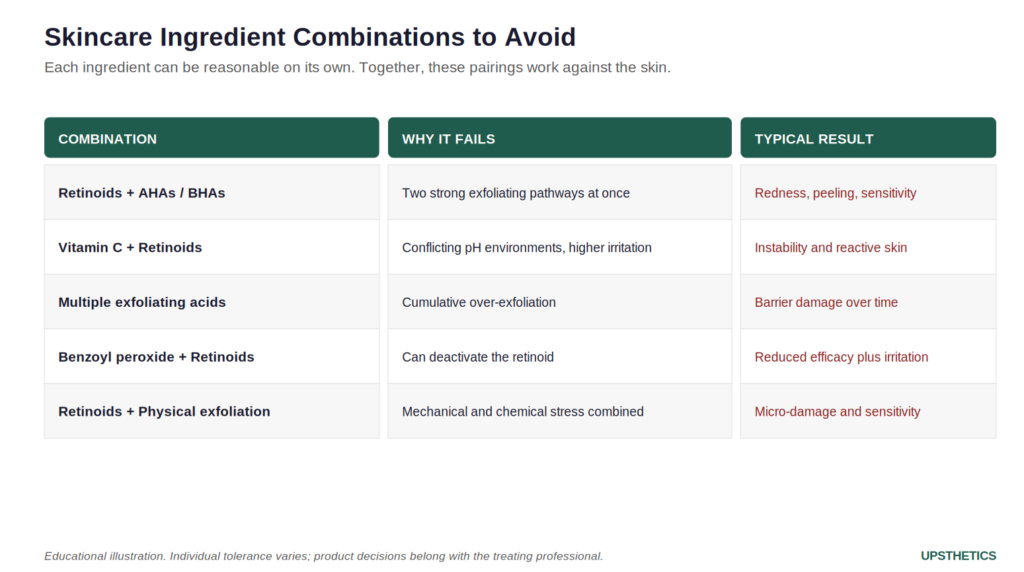
Retinoids + AHAs/BHAs
- High irritation potential
- Increases risk of over-exfoliation Result: redness, peeling, sensitivity
Vitamin C (L-Ascorbic Acid) + Retinoids
- Different pH environments
Increased irritation in sensitive skin Result: instability + reduced tolerance
Multiple Exfoliating Acids
- Glycolic + Salicylic + Lactic Result: barrier disruption + inflammation
Benzoyl Peroxide + Retinoids
- Can deactivate retinoids Result: reduced efficacy + irritation
Retinoids + Physical Exfoliation
- Mechanical + chemical stress Result: micro-damage + sensitivity
Common Mistakes in Aesthetic Practice
Following Trends Instead of Skin Condition
Applying popular combinations without assessing the patient leads to complications.
Ignoring Homecare Products
Many patients already use active ingredients that interact negatively with clinical treatments.
Overloading the Skin
Too many actives at once increases skin sensitivity and reduces tolerance.
Consequences: Clinical and Business Impact
Skin Damage
- Compromised barrier
- Chronic irritation
- Risk of post-inflammatory hyperpigmentation (PIH)
Business Impact
- Poor results
- Loss of patient trust
- Negative reviews
What to Do Instead
Simplify Protocols
Fewer actives, better results.
Assess Before Treating
Always evaluate current skincare routine.
Educate the Patient
Explain why certain combinations should be avoided.
Prioritize Barrier Health
Healthy skin tolerates treatments better and produces consistent outcomes.
The Role of the Esthetician and Aesthetic Medical Assistant
- Identify risky ingredient combinations
- Adjust treatment plans accordingly
- Educate patients on safe skincare routines
- Prevent unnecessary complications
Ingredient knowledge is one of the fastest ways to stand out as a skin professional. Head to the Skin Science section of the Upsthetics blog to keep building it, one evidence informed article at a time.
Which ingredient or interaction should we cover next? Send your suggestion to admin@upsthetics.com.
Disclaimer: This content is for educational purposes only and does not constitute medical advice, legal advice, or professional guidance.
FAQS
Can retinol and glycolic acid be used together?
They can, but not usually in the same routine, especially for beginners or patients with sensitive skin. Using both simultaneously significantly increases the risk of irritation, peeling, and barrier disruption. Alternating nights is often better tolerated.
Is it safe to combine vitamin C and retinol?
It depends on the formulation and the patient’s skin tolerance. Many professionals recommend using vitamin C in the morning and retinoids at night to minimize irritation and optimize performance.
Can salicylic acid and glycolic acid be used together?
Both are effective exfoliants, but combining them can easily lead to over-exfoliation, particularly in sensitive or compromised skin. Clinical assessment should guide their use.
Why should benzoyl peroxide not be combined with certain retinoids?
Benzoyl peroxide can oxidize and reduce the effectiveness of some retinoids, while the combination may also increase skin irritation.
Can too many active ingredients damage the skin barrier?
Yes. Layering multiple acids, retinoids, and exfoliating products can weaken the skin barrier, leading to dryness, redness, burning, and increased sensitivity.
What are the signs of over-exfoliation?
Common signs include persistent redness, tightness, burning, flaking, increased sensitivity, and stinging when applying normally well-tolerated skincare products.
Should patients stop active ingredients before professional treatments?
Often, yes. Depending on the procedure, patients may be advised to pause retinoids, exfoliating acids, or other potent actives for several days beforehand to reduce the risk of irritation. The exact timing depends on the treatment and clinician’s protocol.
Can niacinamide be combined with most active ingredients?
Generally yes. Niacinamide is well tolerated and is frequently paired with retinoids, vitamin C, and exfoliating acids to help support barrier function and reduce irritation.
Does using more active ingredients produce faster results?
Not necessarily. More products do not always mean better outcomes. Well-designed routines with fewer compatible ingredients are often more effective and better tolerated.
How can aesthetic professionals identify problematic ingredient combinations?
A complete consultation should include a review of all skincare products the patient uses at home, including prescription medications, over-the-counter products, and cosmetic treatments. This helps identify combinations that may increase irritation or interfere with clinical procedures.
Can incompatible ingredients cause post-inflammatory hyperpigmentation (PIH)?
Yes. Excessive irritation and barrier damage increase inflammation, which can contribute to PIH, particularly in patients with darker skin tones.
What is the safest approach when introducing new active ingredients?
Introduce one active ingredient at a time, monitor the skin’s response for several weeks, and avoid adding multiple potent products simultaneously. This makes it easier to identify irritation and maintain skin barrier health.
Related posts
Compromised skin barrier: how to identify it before any aesthetic treatment

The Skin Microbiome and Why Aggressive Treatments Backfire
Stay Updated
About the author
