RF Microneedling and Traditional Microneedling, How They Really Differ
Microneedling has become one of the most widely performed skin rejuvenation procedures because of its ability to improve skin texture, acne scars, and overall skin quality with relatively little downtime.
As technology has evolved, radiofrequency (RF) microneedling has emerged as a newer treatment option that combines traditional microneedling with controlled radiofrequency energy.
Although both procedures use tiny needles to create controlled micro-injuries in the skin, they work differently and are designed to address different clinical concerns.
Understanding these differences helps patients and professionals choose the most appropriate treatment based on skin type, treatment goals, and expected outcomes.
What Is Traditional Microneedling?
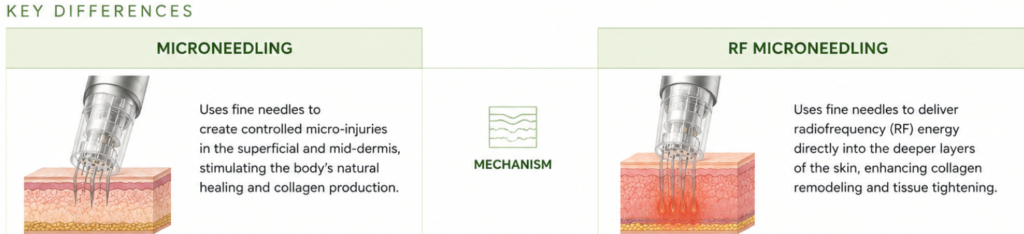
Traditional microneedling, also known as collagen induction therapy, uses fine sterile needles to create thousands of controlled microchannels within the skin.
These microscopic injuries stimulate the body’s natural wound-healing response, leading to collagen remodeling and gradual improvement in skin quality.
Unlike laser resurfacing, microneedling leaves most of the epidermis intact, contributing to relatively short recovery times.
What Is RF Microneedling?
RF microneedling combines mechanical microneedling with radiofrequency energy.
After the needles penetrate the skin, radiofrequency energy is delivered directly into selected tissue depths.
This controlled thermal energy creates additional stimulation beneath the skin while minimizing damage to the surface.
The combination of mechanical injury and heat-induced collagen remodeling allows RF microneedling to target concerns that may respond less predictably to traditional microneedling alone.
How Does Traditional Microneedling Work?
Microneedling initiates a controlled wound-healing cascade.
The process stimulates:
- Fibroblast activity
- Collagen production
- Elastin remodeling
- Tissue repair
- Epidermal renewal
As healing progresses, skin texture gradually improves.
Results develop over weeks to months.
How Does RF Microneedling Work?
RF microneedling follows the same basic principles as traditional microneedling but adds controlled heat.
The radiofrequency energy produces:
- Collagen denaturation
- Collagen remodeling
- Tissue tightening
- Dermal remodeling
- Additional stimulation of fibroblasts
This thermal component distinguishes RF microneedling from conventional collagen induction therapy.
Conditions Treated by Traditional Microneedling
Traditional microneedling is commonly used for:
- Mild to moderate acne scars
- Fine lines
- Enlarged pores
- Uneven skin texture
- Mild pigmentation concerns
- Overall skin rejuvenation
It is frequently combined with:
- PRP
- Topical growth factors
- Professional skincare
Conditions Treated by RF Microneedling
RF microneedling may be selected for:
- Moderate skin laxity
- Acne scars
- Wrinkles
- Enlarged pores
- Neck rejuvenation
- Lower face tightening
- Early jowl formation
- Overall skin tightening
Key Differences
Which Treatment Produces More Collagen?
Both procedures stimulate collagen production.
Traditional microneedling relies primarily on the body’s response to controlled mechanical injury.
RF microneedling combines this response with thermal stimulation, which may enhance collagen remodeling and skin tightening in selected patients.
The amount of improvement depends on multiple factors, including treatment settings, skin condition, and the number of sessions performed.
Skin Tightening
One of the major differences between the two procedures is tissue tightening.
Traditional microneedling may improve skin firmness indirectly through collagen remodeling.
RF microneedling generally provides greater skin tightening because heat energy reaches deeper dermal tissues where collagen remodeling occurs.
Acne Scar Treatment
Both procedures may improve acne scars.
Traditional microneedling is supported by numerous clinical studies demonstrating improvement in rolling and shallow atrophic scars.
RF microneedling may provide additional benefit for selected patients with more complex acne scars by combining collagen induction with thermal remodeling.
Combination treatments are common.
Wrinkles and Fine Lines
Both treatments may soften fine lines.
Patients with more advanced photoaging or early skin laxity may benefit from RF microneedling because of its additional tightening effect.
Enlarged Pores
Both procedures may reduce the appearance of enlarged pores over time through collagen remodeling around the follicular openings.
Downtime
Traditional Microneedling
Most patients experience:
- Redness
- Mild swelling
- Temporary sensitivity
Recovery often occurs within a few days.
RF Microneedling
Recovery may include:
- Redness
- Swelling
- Mild pinpoint crusting
- Temporary warmth
Downtime may be slightly longer depending on treatment intensity.
Pain and Comfort
Both procedures usually involve topical anesthetic.
Patients often describe:
Traditional microneedling:
- Pressure
- Scratching sensation
- Mild discomfort
RF microneedling:
- Similar sensations
- Additional warmth during energy delivery
Comfort varies among individuals.
Safety
In 2025, the FDA issued a safety communication after serious complications were reported with certain uses of RF microneedling, including burns, scarring, fat loss, disfigurement, and nerve damage. These reports do not mean the procedure is inherently unsafe, but they underline why device settings, operator training, and patient selection matter more here than with traditional microneedling.
RF microneedling should never be described simply as a stronger version of standard microneedling.
Both treatments have favorable safety profiles when performed appropriately.
Potential side effects include:
- Redness
- Swelling
- Bruising
- Temporary sensitivity
- Dryness
Complications are uncommon but may include:
- Infection
- Pigment changes
- Delayed healing
- Scarring (rare)
Skin of Color
Both traditional microneedling and RF microneedling may be appropriate for darker Fitzpatrick skin types because they generally preserve much of the epidermis.
However, treatment parameters should always be individualized to minimize the risk of post-inflammatory hyperpigmentation.
Who Is a Good Candidate?
Traditional microneedling may be appropriate for patients seeking improvement in:
- Skin texture
- Mild acne scars
- Fine lines
- Overall skin quality
RF microneedling may be considered for patients with:
- Early skin laxity
- Moderate wrinkles
- Acne scars
- Mild tissue sagging
- Neck aging
Who Should Avoid Treatment?
Treatment may need to be postponed in patients with:
- Active skin infection
- Open wounds
- Active herpes simplex
- Severe inflammatory acne
- Certain medical conditions affecting wound healing
- Unrealistic expectations
Another treatment pair you want compared? Send it to admin@upsthetics.com.
Disclaimer: This content is for educational purposes only and does not constitute medical advice, legal advice, or professional guidance. Device classification and scope of practice vary by state.
FAQS
Which treatment is better?
Neither treatment is universally better. The most appropriate choice depends on the patient’s skin condition, treatment goals, and clinical assessment.
Does RF microneedling hurt more?
Some patients report slightly greater discomfort because of the radiofrequency energy, although topical anesthetic significantly improves comfort.
Can both treatments be combined with PRP?
Traditional microneedling is commonly combined with PRP. RF microneedling may also be combined with regenerative treatments depending on the clinical protocol.
Which treatment has less downtime?
Traditional microneedling generally involves slightly shorter recovery.
Is RF microneedling worth the additional cost?
For patients seeking improvement in skin laxity and tightening, RF microneedling may provide benefits beyond traditional microneedling. The choice should be based on clinical needs rather than cost alone.
How many sessions are usually needed?
Treatment plans vary according to the indication and individual response. Many patients undergo a series of sessions to achieve optimal results.
Can either treatment replace a facelift?
No. While both procedures may improve skin quality and, in the case of RF microneedling, provide modest tightening, neither treatment replaces the results of surgical facial lifting.
Are these treatments safe for darker skin?
When appropriate protocols are followed, both treatments may be performed safely across a wide range of skin types, although individualized assessment remains essential. Choosing between two similar treatments is easier once you understand what each one is physically doing to the skin. Find more comparisons like this in the Injectables & Treatments section of the Upsthetics blog.
Related posts

Crosslinked vs. non-crosslinked hyaluronic acid: key differences in structure, skin quality, and volume support

Chemical peels: benefits, types, recovery, risks, and what to expect
Stay Updated
About the author
