Crosslinked vs. non-crosslinked hyaluronic acid: key differences in structure, skin quality, and volume support

- Hyaluronic acid behaves very differently depending on whether it is crosslinked or non-crosslinked, a distinction that shapes how each formulation is used and what it may realistically support.
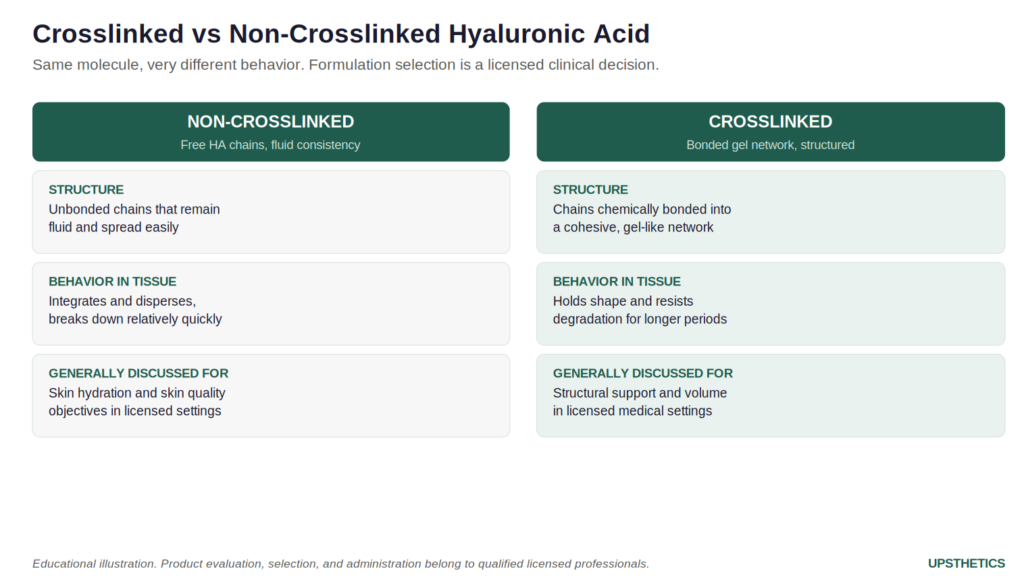
- Non-crosslinked formulations are generally more fluid and are primarily discussed in relation to skin hydration and skin quality objectives.
- Crosslinked formulations have a more structured, gel-like consistency and are generally discussed in relation to structural support and volume in licensed medical treatment settings.
- The selection of the appropriate formulation type is a clinical decision made by qualified licensed professionals, based on treatment objectives, anatomy, and individual patient factors.
- For estheticians and aesthetic medical assistants, understanding these distinctions supports more accurate product knowledge and better-informed client communication within applicable scope-of-practice boundaries.
Hyaluronic acid is one of the most widely used substances in aesthetic medicine, but using the term as if it describes a single, uniform product misses something important. The way hyaluronic acid is formulated determines how it behaves in the skin, what it can realistically support, and in what clinical context it belongs. One of the most consequential distinctions in that conversation is whether a formulation is crosslinked or non-crosslinked.
This is not a minor technical detail. It shapes the entire clinical rationale for using one product versus another, from skin hydration protocols to licensed injectable procedures involving structural volume support. For anyone working in or studying medical aesthetics, understanding this distinction is foundational.
Because scope of practice varies by state, and injectable procedures are subject to regulation, the evaluation, selection, and administration of injectable hyaluronic acid products should be performed under the supervision of a licensed professional and in compliance with applicable laws and regulations.
What hyaluronic acid is and why formulation matters
Hyaluronic acid is a naturally occurring substance found throughout the body, in the skin, connective tissue, and joints, where it plays a well-established role in attracting and retaining water. In its natural state, it is a large, water-binding molecule that contributes to skin hydration, volume, and overall tissue health.
In aesthetic medicine, hyaluronic acid is used in formulations designed to address a range of objectives, from skin quality and hydration to structural volume support. The critical variable that determines which objective a given product may serve is the formulation process itself, particularly whether crosslinking is involved and to what degree.
Depending on formulation, hyaluronic acid products may be discussed in relation to:
- Improved skin hydration and skin texture
- Support for skin quality in non-injectable or minimally invasive contexts
- Structural support in certain licensed injectable treatment settings
- Soft tissue volume support performed by qualified licensed professionals
None of these applications should be conflated. A product designed for skin hydration is not interchangeable with one designed for structural volume support, and vice versa.
What crosslinking means and why it changes product behavior
Crosslinking is a chemical process in which hyaluronic acid molecules are bonded together into an interconnected network structure. Without crosslinking, hyaluronic acid exists as individual chains, relatively fluid and more susceptible to natural enzymatic breakdown. When those chains are linked together, the resulting structure is denser, more cohesive, and more resistant to degradation.
The degree of crosslinking, and the specific technology used to achieve it, varies between products and manufacturers. This means that not all crosslinked hyaluronic acid products behave the same way. Density, cohesivity, integration characteristics, and longevity profiles differ, which is one reason product selection in injectable procedures requires professional clinical judgment rather than a one-size-fits-all approach.
Crosslinking generally affects:
- Consistency and texture of the final product
- Structural behavior once placed in tissue
- Resistance to enzymatic degradation
- Duration characteristics relative to non-crosslinked formulations
Non-crosslinked hyaluronic acid: characteristics and use context
Non-crosslinked hyaluronic acid retains a more fluid, free-chain structure. Because it has not been stabilized through chemical bonding, it integrates readily into the skin and is metabolized more quickly than crosslinked alternatives. This makes it well-suited to applications where the goal is skin quality and hydration support rather than structural correction or volume.
What non-crosslinked formulations are typically associated with
Non-crosslinked hyaluronic acid is most commonly discussed in relation to:
- Skin hydration and improved appearance of dehydrated skin
- Overall skin quality, including texture and radiance
- Supportive roles in broader skin-focused treatment protocols
- Treatments where a more fluid, naturally integrating product is appropriate
It is not typically discussed in relation to structural volume support or contour definition, which require a more stable, structured product.
Duration and product behavior
Non-crosslinked formulations are generally described as having shorter persistence in tissue compared to crosslinked alternatives, which follows from their faster metabolic breakdown. However, duration depends on multiple factors, including the specific product, the treatment area, application technique, and individual metabolism, and should not be assumed or generalized across all non-crosslinked products.
Crosslinked hyaluronic acid: characteristics and use context
Crosslinked hyaluronic acid forms a more structured gel with greater resistance to enzymatic breakdown. The degree of structural integrity varies depending on the formulation, some crosslinked products are designed to be softer and more flexible for superficial or delicate areas, while others are denser and more supportive for deep tissue or high-volume applications. This variation is intentional and reflects the clinical diversity of the procedures in which they are used.
What crosslinked formulations are typically associated with
Crosslinked hyaluronic acid is most commonly discussed in relation to:
- Structural support in licensed injectable treatment contexts
- Volume support in areas where tissue augmentation is a clinical goal
- Contour definition in appropriate clinical settings
- Procedures requiring a product that maintains its position and shape in tissue over time
These are injectable medical treatments. Their evaluation, selection, and administration should be performed by qualified licensed professionals, and their use is subject to applicable state regulations.
Duration and stability
Crosslinking generally increases product stability, which is one reason crosslinked formulations tend to persist longer in tissue than non-crosslinked ones. That said, duration is not a fixed value. It depends on product characteristics, treatment area, injection technique, individual metabolism, and clinical factors specific to each patient. Generalizing timelines across crosslinked products would not be appropriate.
Comparing crosslinked and non-crosslinked hyaluronic acid
How licensed professionals select the appropriate formulation
Choosing between a crosslinked and non-crosslinked hyaluronic acid product, or between two crosslinked products with different density profiles, is a clinical decision that goes well beyond the basic structural distinction. Licensed professionals evaluate a range of factors before selecting a product for any given patient and treatment area.
Considerations typically include:
- The specific treatment objective, hydration, skin quality, volume, or structural support
- The treatment area and its anatomical characteristics
- The patient’s anatomy, skin type, and individual tissue response
- Product density, cohesivity, and integration behavior
- Safety considerations and potential for adverse events
- Patient history and any relevant contraindications
As with other injectable procedures, adverse events may occur, including rare but significant complications. Proper patient assessment, technique, and follow-up are not optional, they are fundamental to responsible practice.
Why this distinction matters in aesthetic education
For estheticians and aesthetic medical assistants, understanding the difference between crosslinked and non-crosslinked hyaluronic acid is not about learning to perform injectable procedures, it is about developing the product literacy needed to support accurate client communication and informed participation in clinical environments.
Clients regularly ask questions about treatments they have read about or seen advertised. Being able to explain, in clear and accurate terms, what different hyaluronic acid products are designed to do, and what distinguishes a skin hydration treatment from an injectable volume procedure, reflects a level of professional knowledge that builds trust and supports better patient outcomes.
It also supports an important professional boundary: understanding what these products are does not imply authority to select, administer, or recommend them outside of the applicable scope of practice. Because scope of practice varies by state, responsibilities in clinical environments depend on local regulations, and those boundaries should be respected.
Sources and references
American Society of Plastic Surgeons. Dermal fillers: hyaluronic acid products and clinical considerations. American Society of Plastic Surgeons.
Kablik, J., et al. Comparative physical properties of hyaluronic acid dermal fillers. Dermatologic Surgery.
US Food and Drug Administration. Dermal filler overview and regulatory framework. FDA.
Have a topic you want us to cover? Write to admin@upsthetics.com and tell us what would help you most in your daily practice.
Disclaimer: This content is for educational purposes only and does not constitute medical advice, legal advice, or professional guidance.
FAQS
What is the main difference between crosslinked and non-crosslinked hyaluronic acid?
The primary difference lies in molecular structure. Crosslinked hyaluronic acid has chemically bonded chains that form a more stable, structured gel, associated with structural and volume support in licensed injectable procedures. Non-crosslinked hyaluronic acid is more fluid and is generally discussed in relation to skin hydration and quality.
Is non-crosslinked hyaluronic acid used for skin hydration?
Yes. Non-crosslinked formulations are most commonly discussed in relation to skin hydration and skin quality objectives. Their more fluid consistency integrates readily and is suited to hydration-focused treatment contexts rather than structural correction.
Is crosslinked hyaluronic acid used for volume and structure?
Crosslinked formulations are generally discussed in relation to structural support and volume in licensed medical treatment settings. The degree of crosslinking varies between products, which is one reason professional product selection involves more than simply choosing ‘crosslinked’ as a category.
Does crosslinked hyaluronic acid last longer?
Generally, crosslinked formulations persist longer in tissue than non-crosslinked ones because of their greater resistance to enzymatic breakdown. However, duration depends on product characteristics, treatment area, technique, and individual factors, and should not be assumed as a fixed outcome.
Can estheticians or aesthetic medical assistants administer injectable hyaluronic acid?
This depends entirely on state regulations and applicable scope-of-practice rules. Injectable procedures involving hyaluronic acid are generally performed by or under the supervision of a licensed medical professional. Estheticians and aesthetic medical assistants working in clinical environments should be familiar with the regulations specific to their state and workplace.
Why is this topic covered in aesthetic education?
Understanding product behavior, formulation differences, and clinical context supports better-informed participation in aesthetic environments, including more accurate client communication and a clearer understanding of where professional boundaries lie. It does not imply authority to perform procedures outside of applicable scope of practice.
Are all crosslinked hyaluronic acid products the same?
No. Crosslinked products vary significantly in density, cohesivity, integration characteristics, and intended use. A product designed for superficial skin support behaves differently from one designed for deep structural augmentation. Product selection is a clinical decision made by qualified licensed professionals. Building solid product knowledge is one of the most valuable investments an aesthetic professional can make. Browse the Injectables & Treatments section of the Upsthetics blog for more evidence-informed articles on the treatments shaping the US aesthetic industry.
Related posts
RF Microneedling and Traditional Microneedling, How They Really Differ

Chemical peels: benefits, types, recovery, risks, and what to expect
Stay Updated
About the author
