Medical spa front desk receptionist: duties, skills, salary, and career path
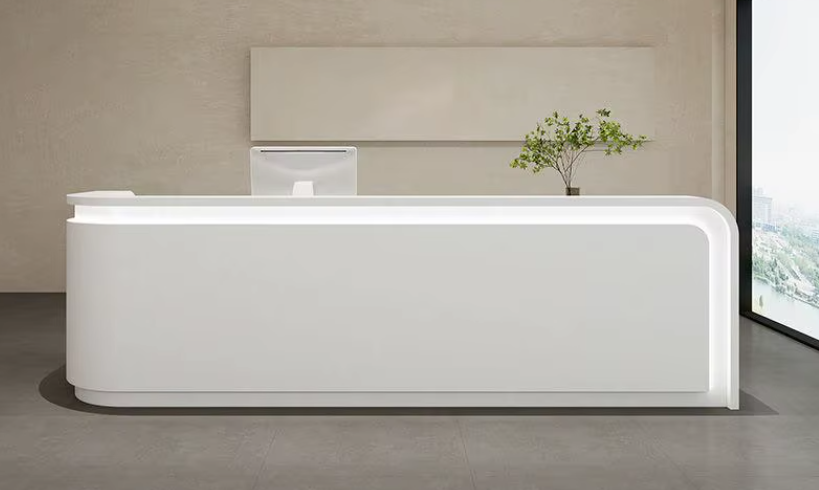
The Medical Spa Front Desk Receptionist is often described as the face of the practice, but in reality, the role goes far beyond greeting patients and answering the phone.
In a modern medical spa, the front desk professional is responsible for creating the first impression, coordinating patient flow, supporting providers, protecting the schedule, ensuring accurate documentation, handling payments, maintaining exceptional customer service, and helping the entire clinic operate efficiently.
A well-trained receptionist can significantly improve patient satisfaction, increase treatment acceptance, reduce scheduling errors, and contribute directly to the financial performance of the business.
Conversely, poor front desk performance can lead to missed appointments, frustrated patients, negative online reviews, lost revenue, and unnecessary stress for the clinical team.
Whether you are considering a career in medical aesthetics or looking to advance within a growing practice, becoming a Medical Spa Front Desk Receptionist can provide an excellent entry point into one of healthcare’s fastest-growing specialties.
What Does a Medical Spa Front Desk Receptionist Do?
A Medical Spa Front Desk Receptionist manages the administrative operations that keep the practice running smoothly while delivering an exceptional patient experience from the first phone call until checkout.
Unlike receptionists in many other industries, front desk professionals in medical aesthetics work within a healthcare environment. This means they must understand patient confidentiality, appointment workflows, documentation standards, aesthetic treatments, provider schedules, payment systems, and customer service at a much higher level.
Although they do not perform medical procedures, they play a critical role in supporting the providers who do.
Typical workplaces include:
- Medical spas
- Cosmetic dermatology clinics
- Plastic surgery practices
- Laser centers
- Cosmetic gynecology clinics
- Hair restoration clinics
- Wellness and longevity clinics
Depending on the size of the business, responsibilities may also include patient coordination, marketing support, treatment plan scheduling, inventory ordering, CRM management, or assisting practice managers with administrative projects.
Why This Position Is So Important
Many clinic owners invest heavily in physicians, nurse injectors, lasers, and interior design.
However, patients usually judge the practice long before meeting the provider.
Their experience begins when they:
- Visit the website
- Call the clinic
- Send an online inquiry
- Receive appointment confirmations
- Walk through the front door
- Wait in reception
- Check out after treatment
Every one of those interactions is heavily influenced by the front desk team.
An excellent receptionist can make patients feel welcomed, respected, and confident.
A poor receptionist can undermine even the best injector or dermatologist.
For this reason, many successful medical spas consider the front desk one of the highest-return investments in the business.
A Typical Day
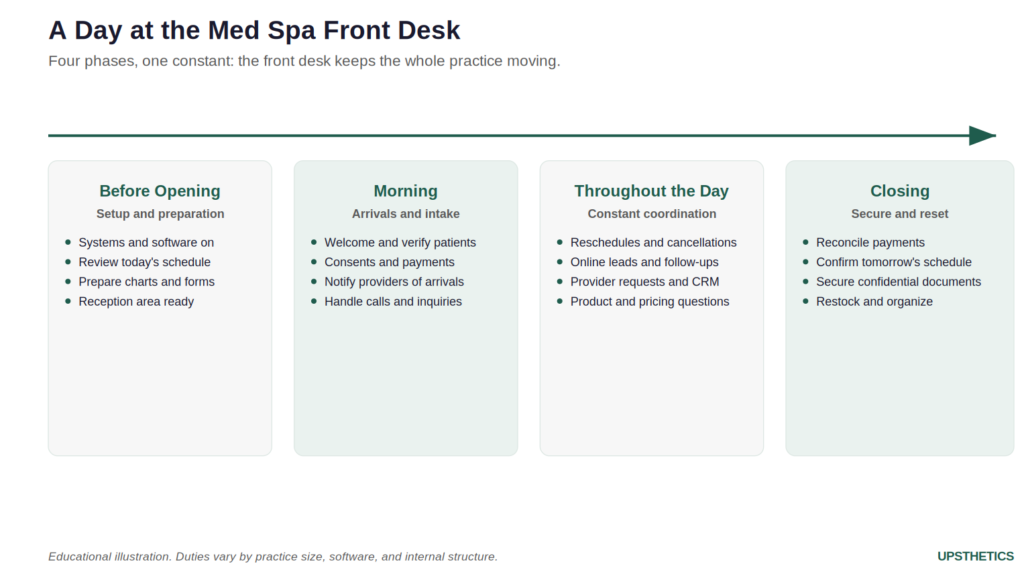
Although every clinic operates differently, a typical day might look like this:
Before opening
- Unlock reception area
- Turn on computers
- Log into scheduling software
- Check emails
- Review today’s appointments
- Verify provider schedules
- Prepare patient charts
- Print consent forms if required
- Ensure reception area is clean
- Prepare beverages
- Check voicemail
- Review online booking requests
Morning appointments
Patients begin arriving.
The receptionist may:
- Welcome patients
- Verify identity
- Update demographics
- Collect insurance information if applicable
- Confirm consent forms
- Process payments
- Notify providers of arrivals
- Coordinate room availability
- Handle incoming calls
- Answer treatment questions within their scope
- Schedule consultations
- Respond to website enquiries
Throughout the day
The schedule constantly changes.
Patients may:
- Arrive late
- Cancel
- Need rescheduling
- Request financing
- Ask about prices
- Need follow-up appointments
- Purchase skincare products
- Request receipts
- Require documentation
Meanwhile providers may ask reception to:
- Contact patients
- Rearrange appointments
- Confirm treatment plans
- Update the CRM
- Coordinate with laboratories
- Order products
- Prepare tomorrow’s schedule
No two days are identical.
Core Responsibilities
Although responsibilities vary, most Medical Spa Front Desk Receptionists are responsible for the following:
Patient Reception
Every patient should feel welcomed immediately.
Responsibilities include:
- Greeting patients professionally
- Maintaining eye contact
- Confirming appointments
- Managing waiting times
- Offering refreshments
- Answering general questions
- Creating a calm environment
The first sixty seconds often determine how patients perceive the entire clinic.
Appointment Scheduling
Scheduling is far more complex than simply finding an available time slot.
Receptionists must understand:
- Provider availability
- Treatment duration
- Room availability
- Device availability
- Combination procedures
- Consultation requirements
- Recovery time
- New patient appointments
- Follow-up appointments
Poor scheduling creates delays throughout the day.
Strong scheduling improves clinic efficiency and profitability.
Telephone Communication
Many prospective patients decide whether to book during their very first phone call.
Receptionists should:
- Answer promptly
- Speak confidently
- Listen carefully
- Avoid interrupting
- Explain processes clearly
- Build trust
- Never pressure patients
The objective is not aggressive selling.
The objective is helping patients feel comfortable taking the next step.
Managing Online Leads
Modern medical spas receive enquiries from:
- TikTok
- Online booking systems
- Website forms
- Live chat
The front desk often becomes responsible for:
- Responding quickly
- Qualifying enquiries
- Scheduling consultations
- Recording lead sources
- Updating the CRM
- Following up with undecided patients
Fast response times dramatically increase conversion rates.
HIPAA and Patient Privacy
Every Medical Spa Front Desk Receptionist works with confidential patient information. Even if you never enter the treatment room, you are responsible for protecting patient privacy and handling sensitive information appropriately.
Many aesthetic practices in the United States are covered by the Health Insurance Portability and Accountability Act (HIPAA), which establishes standards for protecting Protected Health Information (PHI). Patients trust the practice with their medical history, contact information, photographs, payment details, treatment plans, and personal concerns. Protecting that information is one of the most important responsibilities of the front desk team.
Professional receptionists should always:
Verify a patient’s identity before discussing appointments or treatment information.
Avoid discussing patient information where others can overhear.
Lock computers whenever leaving the reception desk.
Never leave patient files unattended.
Follow the clinic’s document retention policies.
Dispose of confidential paperwork securely.
Use only approved communication methods when contacting patients.
Patients notice these details. Respecting privacy helps build trust and reinforces the professionalism of the practice.
Creating an Exceptional Patient Experience
Medical aesthetics is different from many other healthcare specialties.
Most patients are not seeking treatment because they are ill. They are investing their own money to improve their appearance, confidence, or wellbeing. As a result, expectations are often much higher than in traditional healthcare.
The front desk receptionist plays a major role in shaping that experience.
Patients remember:
How quickly the phone was answered.
Whether staff greeted them warmly.
If appointments started on time.
Whether they felt listened to.
How problems were resolved.
How they were treated during checkout.
Whether communication after the appointment was professional.
Outstanding customer service is not about pretending that everything is perfect. It is about making every patient feel respected, informed, welcomed, and valued throughout their visit.
Communication Skills Every Receptionist Needs
Communication is one of the most valuable skills in any medical spa.
Every day, receptionists communicate with:
- New patients
- Returning patients
- Physicians
- Nurse practitioners
- Physician assistants
- Medical assistants
- Estheticians
- Practice managers
- Product suppliers
- Laboratories
- Financing companies
Professional communication involves much more than speaking clearly.
Active Listening
Patients often explain important concerns if they feel someone is genuinely listening.
Avoid interrupting.
Allow patients to explain their questions completely before responding.
Many misunderstandings occur because staff assume what the patient is asking instead of confirming it.
Professional Language
Receptionists should avoid making medical recommendations or promising treatment outcomes.
For example, instead of saying:
- “That treatment will definitely work for you.”
A better response would be:
“One of our providers will evaluate your concerns during your consultation and recommend the most appropriate treatment options.”
This type of language is accurate, professional, and protects both the patient and the practice.
Emotional Intelligence
Patients may arrive feeling:
- Nervous
- Self-conscious
- Excited
- Anxious
- Embarrassed
- Frustrated
The receptionist often sets the emotional tone for the entire appointment.
Remaining calm, empathetic, and professional during stressful situations is one of the characteristics that separates excellent front desk professionals from average ones.
Practice Management Software
Modern medical spas rely heavily on technology.
Receptionists spend much of their day working with digital systems rather than paper files.
Depending on the practice, software may include:
- Electronic Medical Records (EMR)
- Electronic Health Records (EHR)
- Online scheduling platforms
- Customer Relationship Management (CRM) systems
- Payment processing software
- Digital consent forms
- Appointment reminder systems
- Email marketing platforms
- SMS communication software
Many medical spas also use platforms such as:
- Aesthetic Record
- PatientNow
- Zenoti
- Boulevard
- NexHealth
- Google Workspace
- Microsoft 365
Technology changes rapidly, so successful receptionists are comfortable learning new systems throughout their careers.
Collecting Payments Professionally
Many new receptionists feel uncomfortable discussing money.
However, collecting payments is simply another part of delivering professional service.
Patients appreciate transparency.
Receptionists should clearly explain:
- Consultation fees
- Treatment pricing
- Package pricing
- Membership plans
- Financing options
- Cancellation policies
- Deposit requirements
The goal is not to pressure patients into spending money.
The goal is to provide accurate information so patients understand their options and can make informed decisions.
Managing Difficult Patients
Every receptionist will eventually encounter difficult situations.
Patients may become frustrated because:
The provider is running behind schedule.
Their preferred appointment is unavailable.
They misunderstood pricing.
They are unhappy with a treatment outcome.
A cancellation policy applies.
They have been waiting longer than expected.
Professional receptionists remain calm.
Rather than arguing, they focus on solving the problem.
A simple framework includes:
Listen carefully.
Acknowledge the patient’s concern.
Remain calm and respectful.
Explain what you can do.
Involve the provider or practice manager when appropriate.
Most patients do not expect perfection.
They expect honesty, professionalism, and respectful communication.
Time Management
Medical spas operate on carefully planned schedules.
A five-minute delay at reception can quickly affect the entire clinic.
Successful receptionists constantly prioritize tasks while remaining organized.
Common priorities include:
Checking patients in.
Answering incoming calls.
Processing payments.
Updating appointment schedules.
Confirming future appointments.
Responding to online enquiries.
Communicating with providers.
Managing waiting times.
The ability to move efficiently between multiple responsibilities is one of the most valuable skills a front desk professional can develop.
Daily Opening Checklist
Before the first patient arrives, receptionists should ensure that the clinic is ready for the day.
Typical opening tasks include:
Reviewing the day’s schedule.
Confirming provider availability.
Logging into practice management software.
Checking emails and voicemail.
Reviewing online appointment requests.
Preparing patient charts.
Organizing consent forms.
Testing payment terminals.
Ensuring the reception area is clean and welcoming.
Confirming that treatment rooms are ready.
A consistent opening routine helps the clinic begin each day efficiently.
Daily Closing Checklist
At the end of the day, receptionists help prepare the practice for the following morning.
Closing responsibilities often include:
Confirming the next day’s appointments.
Processing outstanding payments.
Securing patient records.
Logging out of all computer systems.
Organizing the reception area.
Restocking forms and office supplies.
Forwarding phones if required.
Ensuring confidential documents are stored securely.
Strong closing procedures reduce errors and improve efficiency the following day.
Salary Expectations
Compensation for medical spa front desk receptionists in the United States varies by market, practice type, and experience. Many roles are paid hourly, and postings in larger markets often include performance incentives tied to retail sales or booking targets.
Because titles and duties vary widely between practices, the most reliable approach is to review current local job postings and compare responsibilities carefully. As a general reference, front desk and reception roles in medical settings typically sit above general reception averages when they include scheduling software management, payment handling, and lead management responsibilities.
The more operational responsibility the role includes, the stronger the negotiating position.
Career Growth Path
Front desk is one of the most strategic entry points into the aesthetic industry, precisely because it touches every part of the operation.
Common growth paths include:
- Patient coordinator, taking ownership of consultations, treatment plans, and follow-up
- Lead front desk or front office supervisor in larger practices
- Practice manager, overseeing operations, team, and performance
- Transition into clinical support roles, such as aesthetic medical assistant, with additional training
Professionals who master scheduling logic, patient communication, and practice software often advance faster than those who treat the role as purely administrative.
Sources and references
- U.S. Bureau of Labor Statistics. Occupational Outlook Handbook: Receptionists.
- U.S. Department of Health and Human Services. HIPAA privacy and security resources.
The front desk is where great aesthetic practices are won or lost, and the professionals who master it rarely stay entry level for long. Find more role guides and career resources in the Careers section of the Upsthetics blog.
Working front desk and want us to cover a specific challenge? Write to admin@upsthetics.com.
Disclaimer: This content is for educational purposes only and does not constitute medical advice, legal advice, or professional guidance.
FAQS
Do you need experience to work as a med spa front desk receptionist?
Not always. Many practices hire candidates with customer service or administrative backgrounds and train them on aesthetic workflows. Familiarity with scheduling software and professional communication helps significantly.
Is a license or certification required?
No license is required for front desk roles. HIPAA awareness, CPR certification, and software proficiency are valued by many employers, and some practices provide internal training on privacy and protocols.
What is the difference between a front desk receptionist and a patient coordinator?
The front desk manages arrivals, scheduling, calls, and payments. A patient coordinator typically owns the consultation journey, treatment plan follow-up, and longer-term patient relationships. In smaller practices, one person may cover both.
Can this role lead to a management position?
Yes. Practice managers frequently start at the front desk, because the position builds a complete view of how the clinic operates, from patient flow to revenue.
Related posts
Medical spa patient coordinator: duties, skills, salary, and career guide
How to start working in a medical aesthetic clinic: roles, skills, and career path
How to become an aesthetic medical assistant: skills, role, and career path in medical aesthetic clinics
Stay Updated
About the author
