How to Recognize a Vascular Occlusion and What Has to Happen Next
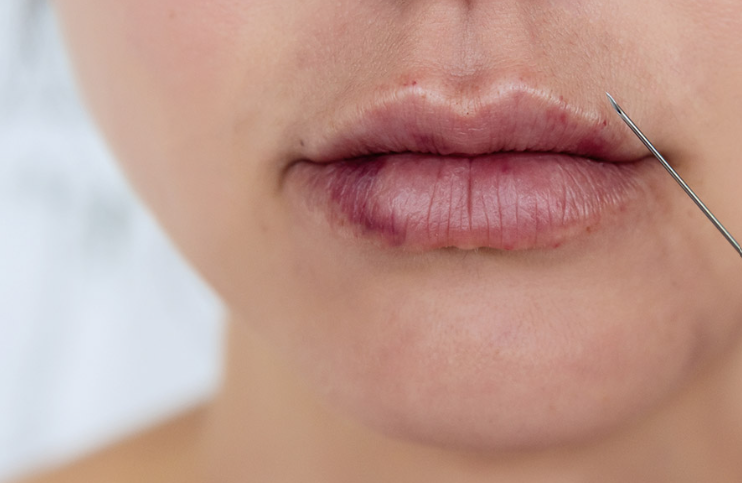
Vascular occlusion is the complication that defines how seriously an aesthetic practice takes safety. It is rare, it is time critical, and its outcome depends almost entirely on how fast it is recognized rather than on how skilled the injector was. Filler placed into or compressing an artery interrupts blood supply to the tissue that vessel feeds. Left unresolved, that tissue dies. In the worst cases involving the ophthalmic circulation, the result is permanent vision loss.
Clinical support staff are frequently the first people to hear about it, because the patient calls the front desk before she calls anyone else. That makes recognition a whole team competency, not an injector competency.
What actually happens
There are two mechanisms. Filler can be injected directly into the lumen of an artery, or it can be placed alongside a vessel in sufficient volume to compress it externally. Intravascular injection is the more dangerous of the two because the material travels. Pushed under pressure, product can move backward against flow and then forward into branches the injector never touched, which is how a treatment in the nasal or glabellar region produces a problem at the retina.
The regions carrying the highest documented risk are the glabella, the nose, the nasolabial fold and the forehead, largely because of anastomoses between the facial circulation and the ophthalmic artery. Risk is never zero anywhere on the face.
The signs, in the order they usually appear
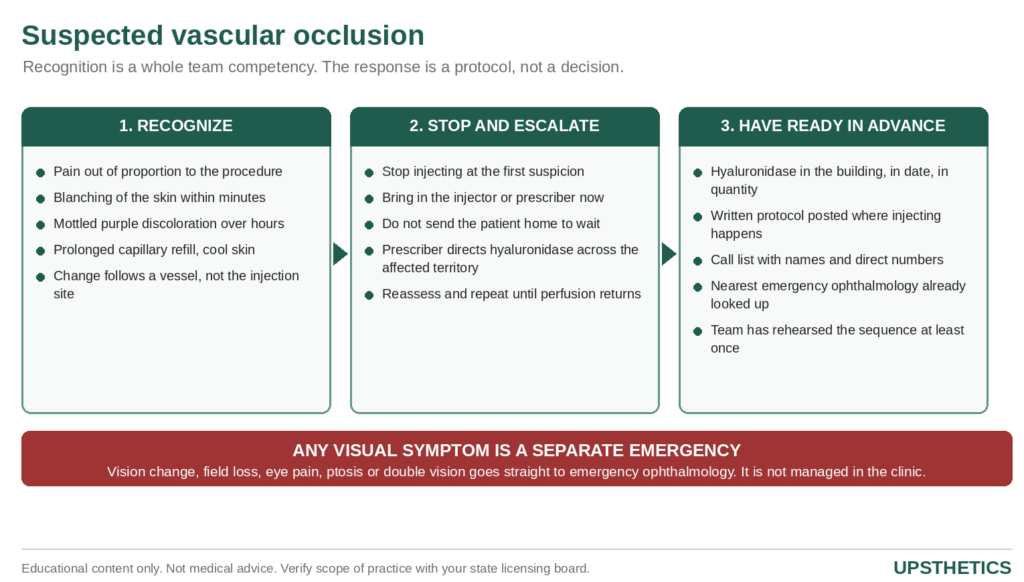
Pain that is out of proportion to the procedure is the earliest and most reliable warning. Injection is uncomfortable. Severe, sustained, escalating pain is not normal and should never be reassured away. Absence of pain does not exclude occlusion, since anesthetic and nerve blocks can mask it, but its presence is a red flag that requires assessment rather than a phone reassurance.
Blanching appears immediately or within minutes. The skin over the affected territory turns pale or dusky white as perfusion drops. It may be subtle and it may be mistaken for the blanching that follows local anesthetic with epinephrine, which is exactly why the injector should know which product was used and where.
A mottled, net like purple discoloration follows within hours as the territory becomes congested. Prolonged capillary refill in the affected area, a cool feel to the skin, and the pattern of change following the anatomic course of a vessel rather than the shape of the injection site all point in the same direction.
Over the following days, untreated occlusion progresses to blistering, then to dusky necrosis, then to eschar and scarring. Every one of those stages represents a window that was open earlier and closed.
Ocular involvement is a separate emergency. Sudden vision change, visual field loss, eye pain, ptosis or double vision during or immediately after facial injection requires immediate transfer to emergency ophthalmology. This is not managed in a med spa treatment room.
The response is a protocol, not a decision
The single most useful thing a practice can do is remove judgment from the moment it happens. Injection stops immediately at the first suspicion. The injector or prescriber is brought into the room without delay, whatever else is happening in the schedule. The patient is not sent home to see how it looks tomorrow, and is not told to take an antihistamine and call back.
Definitive management of hyaluronic acid occlusion is hyaluronidase, delivered promptly and in adequate quantity across the affected vascular territory rather than a token amount at the injection point, and repeated on reassessment until perfusion returns. Dosing, dilution and repeat intervals are prescriber decisions made against a written protocol and current consensus guidance, and they are not something a support team member calculates or administers. Adjunct measures such as warmth, massage and other supportive steps are directed by the clinician and vary between protocols.
Two facts drive everything else. Hyaluronidase reverses hyaluronic acid and does nothing for calcium hydroxylapatite, poly L lactic acid or permanent fillers, which is one reason those materials carry a different risk conversation. And time matters enormously. Tissue tolerates ischemia for a limited period, so a practice that has to locate hyaluronidase, find a vial in date, or wait for a prescriber to drive across town has already lost the part of the outcome it controlled.
Preparedness is the part staff own
An emergency kit that exists on paper is not preparedness. Someone has to own it. Hyaluronidase must be physically present in the building on every day filler is injected, in a quantity sufficient for a genuine flooding protocol rather than a single vial, stored correctly, and checked against expiry on a scheduled basis with the check recorded. Expired hyaluronidase discovered during an emergency is a recurring theme in published case reports.
The written protocol should be posted where the injector works, not filed in a binder in an office. It should name who is called, in what order, with what phone numbers, and where the nearest emergency ophthalmology service is located with its address and direct line already looked up. Staff should have rehearsed it. A team that has walked through the sequence once behaves completely differently from a team reading it for the first time with a frightened patient in the chair.
Documentation runs alongside. Photograph at recognition and at each reassessment, record times rather than approximations, record product, volume, region and lot, record every dose given and by whom, and record every instruction given to the patient. This protects the patient’s continuity of care first and the practice second.
Handling the call that comes in later
Many occlusions declare themselves after the patient has gone home. The front desk needs a rule it cannot get wrong, and the rule is simple. Any patient calling after filler with severe or worsening pain, skin color change, coolness, blistering or any visual symptom is not triaged, not scheduled for next week and not reassured. She is routed to the injector or prescriber immediately, and if that person cannot be reached within minutes, she is directed to emergency care.
The instinct to soften bad news and avoid alarming a patient is exactly the instinct that costs tissue here. It is far better to bring in five patients who turn out to have ordinary bruising than to talk one patient out of coming in.
Scope and state variation
Who may inject filler, who may administer hyaluronidase, what supervision must be in place and whether the supervising physician must be physically present are set at state level and differ substantially. Medical assistants do not administer hyaluronidase. Confirm the framework that applies to your practice with the state medical board and the state nursing board, and make sure the answer is reflected in the written protocol rather than assumed.
Check two things in your own clinic today. Whether there is hyaluronidase in the building right now, in date and in adequate quantity, and whether every person who answers the phone knows the rule for a post filler call. If either answer is uncertain, that is the highest value hour of work available to your practice this week. Tell us what you found at admin@upsthetics.com.
This article is educational and is written for clinical support staff. It does not constitute medical advice, emergency guidance or a treatment protocol, and it deliberately does not provide dosing information. Management of vascular occlusion is directed by a qualified prescriber against current consensus guidance. Scope of practice, delegation and supervision requirements vary by state and change over time. Verify current requirements with your state licensing board and follow the written protocols of your supervising physician.
FAQS
What is the first sign of a vascular occlusion?
Pain out of proportion to the procedure, usually with blanching of the affected area within minutes. Mottled purple discoloration and prolonged capillary refill follow within hours.
How quickly does it need to be treated?
As fast as possible. Tissue tolerates loss of blood supply for a limited period, and outcomes worsen with every hour of delay. Suspicion alone is enough to stop and escalate.
Does hyaluronidase work on every filler?
No. It dissolves hyaluronic acid only. It has no effect on calcium hydroxylapatite, poly L lactic acid or permanent fillers, which is part of the risk discussion for those materials.
Can a vascular occlusion cause blindness?
Yes, though it is rare. Product reaching the ophthalmic circulation can cause sudden and often permanent vision loss. Any visual symptom during or after facial injection is an immediate emergency referral.
What should the front desk do if a patient calls with these symptoms?
Route the call to the injector or prescriber immediately without triaging or scheduling. If that person cannot be reached within minutes, direct the patient to emergency care. Before you close this tab
Related posts

Infection control in medical aesthetic clinics: essential safety protocols for estheticians and assistants

Can patients with diabetes get Botox? Clinical considerations and safety overview
Stay Updated
About the author
